Case study · Pier
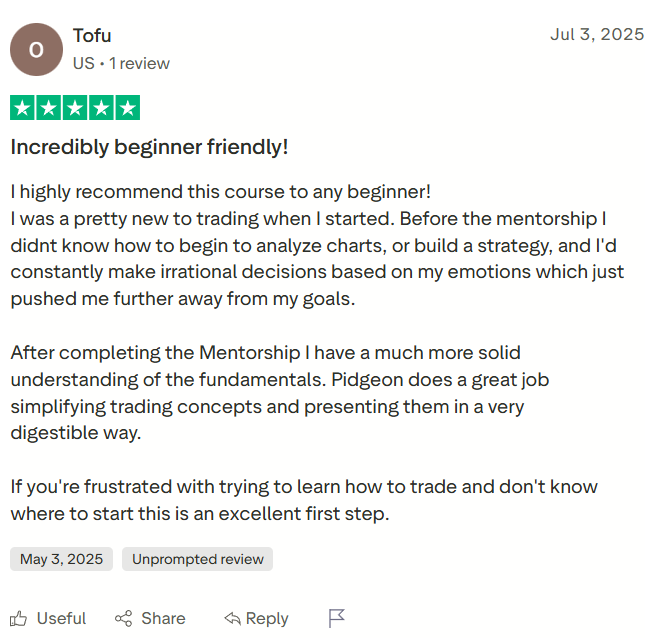
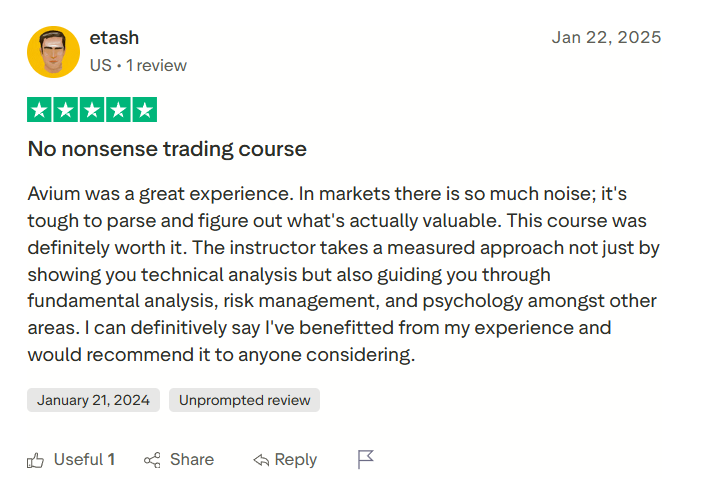
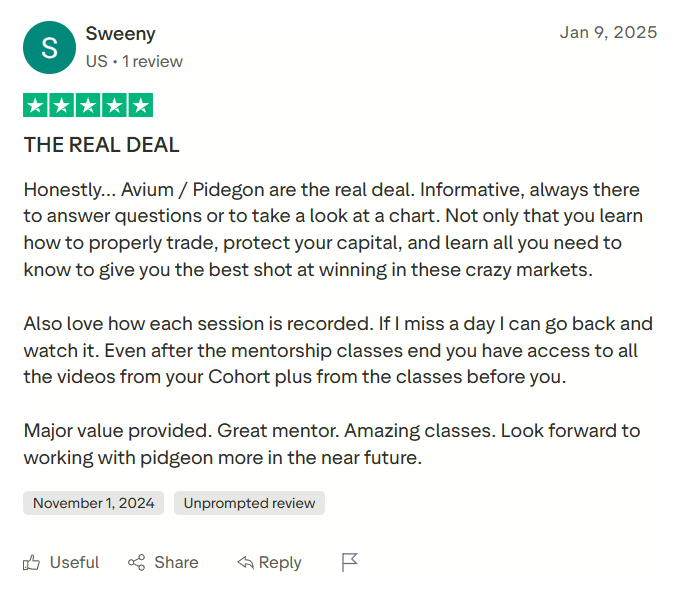
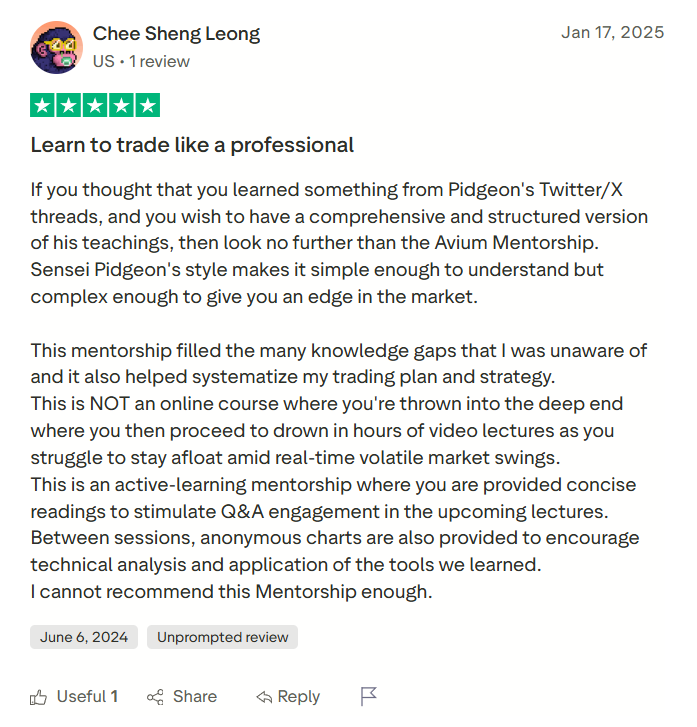
He went from following signals to being a confident trader
Below is the story of one of my favourite students, Pierluigi.
Pier, like many others, was looking for another source of income; that's what brought him to the world of trading. But trading didn't quite play out the way he imagined, spending years without making any real money.
That all changed when he joined the mentorship.
Here is his story:
Where Pier started
Pier wasn't new to trading.
He had been around for a couple of years, trying to make it work. Like most new traders he tried to follow calls, and take trades here and there.
Before the mentorship, I was just copy trading from Telegram groups.
But there was a problem.
He wasn't really making his own decisions. Most of what he did came from following other people's calls.
I didn't know how to trade for myself; and my risk management was not it...
And over time, that added up to the same outcome:
I wasn't making any money.
Despite trading for 2 years, nothing was really improving.
Where things broke down
At some point, it stopped being just "part of the process" and it started feeling like a dead end.
Honestly... I was just fucking everything up.
He found himself at a crossroads... Either give up on trading, or start to take it seriously.
I needed to diversify my skill set.
I wanted a new job opportunity... in case everything goes south.
Trading was supposed to become a second stream of income. Something reliable.
Instead, it was inconsistent and unclear.
Trying more signal groups didn't fix it either.
I tried more channels... just to have more people telling me what to buy.
In the end it was just more noise for nothing.
Eventually, he made his choice.
I'd rather learn how to fish than buy the fish from the fisherman.
The shift: taking it seriously
That's when Pier decided to approach trading differently.
Instead of looking for better signals, he decided to actually learn how it works.
I needed the whole course... I was not a trader at all.
This wasn't about adding another strategy or indicator.
It was about starting the right way, and building a solid foundation.
What started to click
As he worked through the mentorship, things began to make more sense.
Not in a "magic moment" kind of way, but gradually, through understanding how charts actually behave. He started to recognize the setups in real time:
I remember... it was testing support multiple times, and I remembered from the lesson that it's more likely to break... and it happened exactly.
More importantly, he stopped feeling like he was guessing.
It gave me more confidence.
Now I can see what I could do with the chart and compare it with the trader's idea.
He could follow a trade and understand why it made sense (or why it didn't).
What he did differently
The biggest change wasn't just what he learned, but how he applied it.
He didn't jump straight into high-risk trades.
He slowed things down.
I started with paper trading for a couple of weeks to a month.
Then he eased into live trading:
Then I started to put on small-sized trades.
By the end of the mentorship, he built his own approach instead of copying someone else's.
I could figure stuff out myself after the mentorship.
I didn't have to rely on people telling me what to buy or sell.
The results
Before the mentorship, his results weren't great.
Before it was definitely on the negative side... or break-even.
After completing it, that changed:
Since I started trading, I've had some good success.
And now:
I could definitely just trade by myself at this point.
That's probably the most meaningful change.
Not just that he's making money, but that he doesn't need a signal group to do so.
As he puts it:
The big change... I'm a profitable trader now.
How he sees it now
Pier doesn't pretend to have everything perfected.
I'm not the Warren Buffett of trading.
But that's not really the point.
He's consistent, he understands what he's doing, and he sees where it can lead.
I'm happy with the way I'm doing right now.
Trading has opened a door to something bigger.
It's no longer just something he's trying on the side.
It's a skill he can build on and rely upon.
Who this makes sense for
Pier's not coming at this from a "natural talent" angle.
If anything, he was unsure at the start:
I was really concerned that I wasn't smart enough to do it.
What made the difference was simply deciding to try, and to take it seriously.
I invested into myself... to learn a real-life skill that can help me forever.
In his words, this is best suited for:
Anyone seriously interested in trading... Anyone willing to learn.
Closing thought
For a long time, Pier was active in the market but not really improving.
Once he made the switch from following others to taking the mentorship and learning how to do it himself, things started to improve.
It wasn't instant. It wasn't perfect.
But it was progress, and he got there.
If you are like Pier was, stuck following calls and relying on others; not knowing how to progress.
Then consider booking an evaluation call, we'll go through your situation and figure out how we can best help you.
Apply for group mentorship
Case study · Michael
How Michael went from forcing trades to trading with ease
Below is the story of Michael, a past student who I had the pleasure of teaching.
He was an experienced investor who tried to expand into the world of trading, but he faced more challenges than expected.
Here's how our mentorship helped Michael become a successful trader:
Michael's start: strong investor, weak trader
Michael didn't come into trading clueless about money.
In fact, he was doing well, just not in trading.
Before I ever talked to you... I would just invest... and I was doing good enough that I had enough profit to dabble in trading.
Investing made sense to him. It was structured, patient, predictable.
Trading was the opposite.
It's a totally different ball game than investing... different mindset, strategies.
So when he started trading, he did what most people do:
He tried to figure it out on his own.
The early phase: confidence one moment, clueless the next
At first, it felt like he was getting somewhere.
There were points where I'd look at charts and be like, "I have a strong feeling about what's going to happen."
But that wasn't consistent.
Most of the time, it looked more like this:
There was so much more time where I'd look at the charts and be like, I don't have any clue what's going on.
The problem wasn't effort.
It was a lack of consistency. A constant switch between confidence and complete uncertainty.
And instead of stepping back during those unclear moments...
He kept trading anyway.
I was still trying to trade through those moments where I didn't quite know... going with my best guess.
The real issue: treating trading too casually
Looking back, Michael can point to a bigger issue.
It wasn't strategy. It was mindset.
Not respecting how slow you need to go.
Expecting inordinate gains.
He didn't respect his money because he could just make it back at his job.
If I lose $100 this week it's not that big of a deal... but obviously it really is.
That thinking leads somewhere predictable:
You're putting yourself in a position where you're going to lose everything really fast.
If you didn't respect the $100 before, you're not going to respect the $1,000.
And even when trades worked, as he tried to grow he'd give it all back.
One step forward, two steps back.
The frustration: no real edge
The most frustrating part wasn't just losing.
It was not knowing if anything he was doing actually worked.
I never felt like I had even a 51% edge.
Which leads to the classic cycle:
- Win a bit
- Increase size
- Give it all back
You win some... then one loss takes out all the profits.
At that point, it stops feeling like a system.
It just feels random.
The turning point: realizing more money wasn't the fix
Like many traders, Michael had a theory about what would fix things.
I just feel like I need to put in more money... then I'll care more.
And he already knows what that sounds like now:
That's just such an excuse that I think everyone gives themselves.
Instead of adding more capital, he took a different route:
He looked for people who actually knew what they were doing.
I always try to find people who are smarter than me... and listen to what they have to say.
That led him into the mentorship.
What changed: from reacting to being prepared
One of the biggest shifts wasn't about new indicators or signals.
It was preparation.
Charting on high time frames... finding price points that are really important.
Instead of reacting in the moment, he started planning in advance.
Having those things helps a ton when something volatile is happening.
Being prepared... based off of past.
That changes how you behave when things get messy.
When everyone's unsure... that's when they're scared... that's when I'm like alright, I'm longing here.
Not because of emotion, but because the level was already there.
The breakthrough: patience and asymmetric trades
The biggest "click" moment came from understanding how trades should actually be structured.
You find these high time frame ideas... where your invalidation is close.
Which leads to a very different type of trade:
- Small risk
- Large upside
- No need to force entries
And what that really requires:
That comes down to patience.
It moves your trading from searching for trades to letting the market come to you.
What he did differently (and what didn't work)
Michael didn't just blindly follow one method.
He tested three different methods: the method he learned in the mentorship vs. two other methods.
I had three different exchanges... each with a different strategy.
And the results were clear:
Two accounts died and one survived.
The aggressive indicator-based strategy?
That was the first one to blow up... to zero.
Then there was the patient, low leverage DCA strategy.
That lasted longer... but still died.
The one that survived?
The one where I was closest to Pidgeon's strategy.
That experience forced a change:
I was forced to manage my risk the way you taught me.
The results: consistency instead of swings
Before:
One month was good, the next month was terrible... I'd try hard and still be break even.
After:
It's rare for me to end up negative.
And in terms of actual performance:
This past 30-day period... I've made around 35%.
More importantly, it's not dependent on market conditions anymore.
Everyone's saying this is a hard time... and I'm not feeling it at all.
How he thinks about trading now
One of the biggest shifts is how he separates trading from investing.
Trading is a whole different profession.
He's no longer attached to direction or bias.
You have to not fall in love with things and take it as it comes.
And instead of chasing one big outcome, he focuses on stacking smaller, repeatable gains.
Now I'm really in that mindset... focusing on percentages.
The bigger outcome: flexibility
This is where his perspective really changes.
Before, his results depended on the market going up.
Now:
Whether things go up or down, I have a license to profit.
That's a very different position to be in.
It's no longer a matter of bull market vs. bear market, he can win either way.
Who this is for
Michael is pretty direct about this.
This isn't for people chasing quick wins.
It needs to be someone who is actually trying their hardest.
Someone who's willing to listen... not stuck in their ways.
And especially:
Someone who understands you're not going to get rich in one trade.
Closing thought
Michael didn't start from zero.
Through his investing he already understood money.
But there was a gap:
What was he supposed to do when the market didn't do what he wanted?
Once he slowed down, learned real trading, and stopped forcing trades, that gap started to close.
Michael has since joined the top 10% of traders: the profitable ones.
Apply for group mentorship